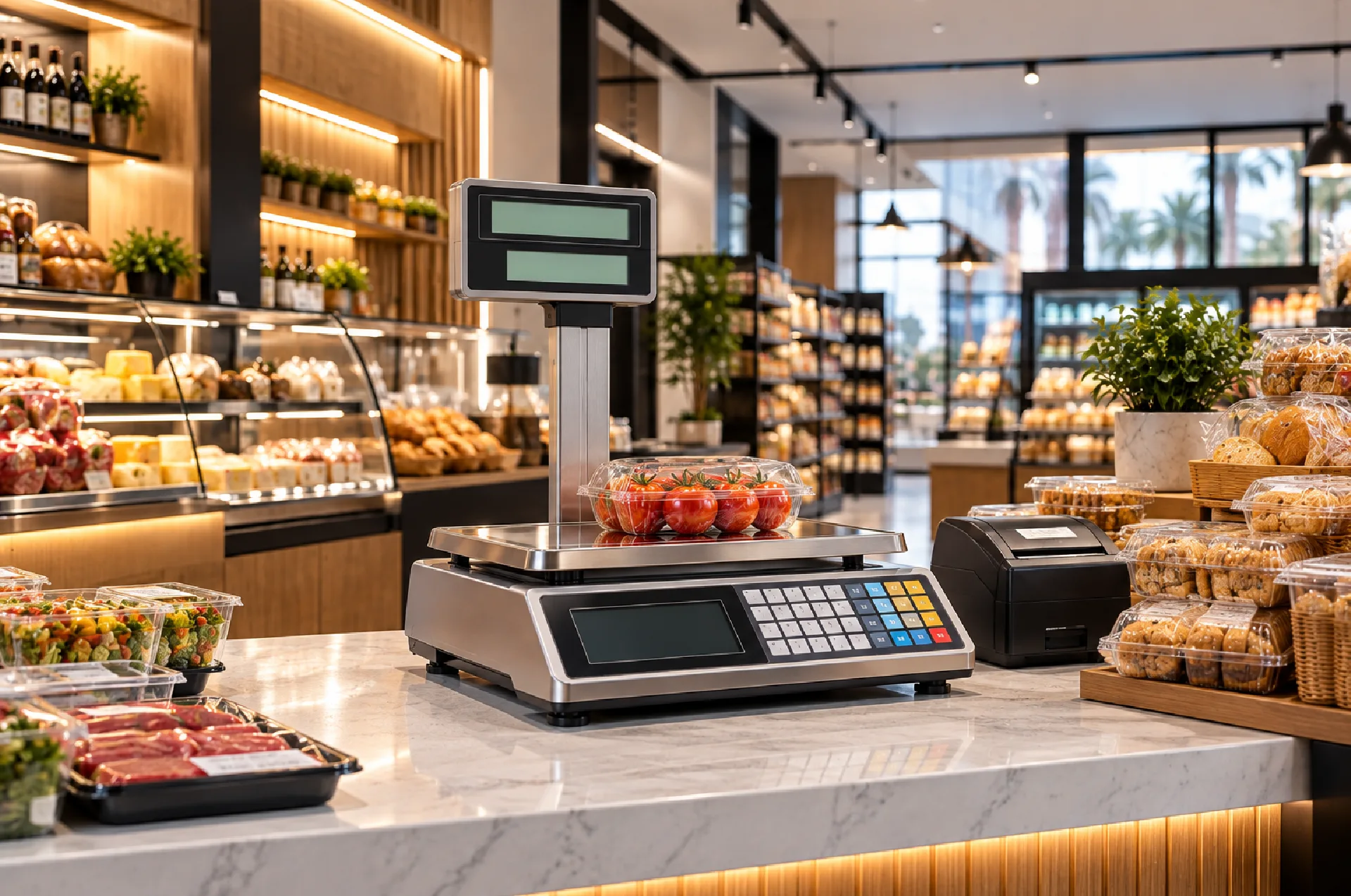
In a busy supermarket, customers do not want to wait while staff calculate the price of fruit, vegetables, meat, nuts, sweets, or other products sold by weight.
The traditional method is simple but slow: weigh the item, note the weight, multiply it by the price per kilogram, and enter the result into the billing system.
A price computing scale removes most of those steps.
The operator places the product on the scale, enters or selects the unit price, and the scale calculates the total selling price automatically. For stores that sell dozens or hundreds of weighed products every day, this can make checkout faster and reduce manual pricing mistakes.
For supermarkets, grocery stores, butcher shops, produce counters, and other retail businesses, price computing scales provide a practical link between weighing and billing.
What Is a Price Computing Scale?
A price computing scale is a retail weighing scale that calculates the selling price of an item based on its weight and unit price.
The scale usually displays three key values:
- Product weight
- Price per kilogram or other unit
- Total price
For example, imagine that apples cost AED 8.50 per kilogram.
A customer selects 1.75 kg.
Instead of asking an employee to calculate the price manually, the scale calculates:
1.75 kg × AED 8.50 = AED 14.88
The operator can see the result immediately.
This simple function makes price computing scales especially useful for businesses that sell loose goods by weight.
Why Retail Businesses Use Price Computing Scales
Speed is the most obvious benefit, but it is not the only one.
Retail businesses need weighing equipment that supports:
- Fast customer service
- Accurate pricing
- Easy operation
- Clear displays
- Reliable daily use
- Simple product handling
A normal digital scale may show only weight. A price computing scale adds the pricing calculation directly into the weighing process.
That can remove an extra step every time staff weigh a product.
Across hundreds of transactions, the time savings can become significant.
1. Faster Checkout at Busy Counters
Retail stores can become crowded during evenings, weekends, holidays, and promotional periods.
Every additional calculation slows the queue.
At a produce counter, butcher shop, or deli, employees may weigh several products for a single customer.
A price computing scale lets staff enter the unit price and receive the final amount instantly.
This can reduce the time spent switching between a calculator, price list, and weighing scale.
The process becomes simple:
Place product → enter unit price → read final price.
That workflow helps staff serve more customers with fewer unnecessary steps.
2. Fewer Manual Pricing Errors
Manual calculations create opportunities for mistakes.
An employee may:
- Enter the wrong weight
- Multiply by the wrong unit price
- Make a calculator error
- Read the display incorrectly
- Round the total inconsistently
A price computing scale automates the calculation based on the measured weight and entered price.
This does not remove every possible human error because the operator still needs to use the correct product price.
It does reduce the chance of mistakes during the multiplication itself.
For retailers processing large numbers of weighed products, consistent price calculation improves both efficiency and customer confidence.
3. Clear Information for Customers
Retail weighing should feel transparent.
Many price computing scales use displays that allow both the operator and customer to see the transaction.
A customer-facing display may show:
Weight: 0.850 kg
Unit price: AED 24/kg
Total: AED 20.40
This gives customers a clear view of how the final price was calculated.
That can reduce questions at the counter and make the buying process easier to understand.
Clear pricing matters especially for products where customers choose different quantities each time.
4. Ideal for Fruit and Vegetable Shops
Fresh produce is one of the most common applications.
Customers rarely buy exactly one kilogram of tomatoes, apples, onions, oranges, or other produce.
The final quantity could be 0.65 kg, 1.37 kg, or 2.15 kg.
A price computing scale calculates the selling price from the exact weight.
This makes it useful for:
- Supermarket produce departments
- Fruit and vegetable shops
- Grocery stores
- Market counters
- Fresh-food retailers
The scale allows employees to handle irregular quantities without performing manual calculations for every customer.
5. Useful for Meat, Poultry, and Seafood Counters
Meat and seafood products also sell in variable quantities.
One customer may request 750 g of meat while another orders 1.4 kg.
The store needs to charge each customer according to the exact amount purchased.
A price computing scale can make this process faster.
Wet food environments also create another consideration: moisture.
Businesses that operate in meat, poultry, seafood, or frequent-cleaning areas should evaluate whether the scale has suitable protection for the environment.
Our guide on Waterproof Weighing Scales: Benefits for Food and Industrial Businesses explains what to consider when weighing equipment may face splashes, humidity, or regular washdowns.
6. Better Control Over Products Sold by Weight
Price computing scales help retailers maintain a consistent process for loose goods.
Common examples include:
- Nuts
- Spices
- Sweets
- Dry fruits
- Coffee
- Tea
- Grains
- Bakery items
- Frozen products
When staff follow the same weighing and pricing process for every customer, the store creates more consistent transactions.
That matters for customer service and internal control.
A business should still maintain accurate product prices and update them whenever prices change.
The scale works best when reliable weighing and reliable pricing data work together.
7. PLU Memory Can Save More Time
Some price computing scales support PLU, or Price Look-Up, functions.
A PLU lets the store save product information under a code.
For example:
- 101 = Apples
- 102 = Tomatoes
- 103 = Almonds
- 104 = Chicken breast
Instead of entering the price every time, the employee selects the stored product code.
The scale retrieves the price and calculates the total.
This can reduce repeated data entry in businesses that sell the same weighed products throughout the day.
Before buying, check how many PLUs the scale can store if this function matters to your operation.
8. Capacity and Readability Still Matter
Retailers sometimes focus heavily on the price-computing feature and forget the weighing specifications.
That can lead to the wrong scale.
Consider the maximum quantity customers usually purchase.
A small grocery counter may never need to weigh more than 15 kg at once. Another business may regularly handle heavier boxes or bulk products.
Readability also matters.
A scale that displays weight in smaller increments can show more detailed weight changes.
The right balance depends on the product and selling process.
A high-capacity scale is not automatically better if the business mainly sells small quantities.
9. Tare Function Helps With Containers
Many retail products sit inside trays, bowls, bags, or containers during weighing.
Customers should pay for the product—not the container.
The tare function removes the container weight from the measurement.
For example:
An empty tray weighs 0.250 kg.
The employee places it on the scale and presses tare.
The display returns to zero.
When 1.2 kg of product goes into the tray, the scale calculates the selling price from the product weight rather than the combined tray and product weight.
This makes tare one of the most important everyday functions in retail weighing.
10. Battery Backup Can Help Retail Operations
Not every retail counter sits close to a convenient electrical outlet.
Some businesses also want the scale to continue operating during short power interruptions.
A rechargeable battery or backup power option can improve flexibility.
This can help:
- Small grocery shops
- Market stalls
- Temporary counters
- Mobile retail setups
- Stores with frequent power interruptions
Battery life should match the store’s working hours.
A scale that needs frequent charging can become frustrating during peak sales periods.
11. Hygiene and Cleaning Matter
Retail food scales come into contact with products, packaging, and customer orders all day.
Employees need to clean them regularly.
Choose a weighing surface that staff can wipe easily.
For wet or hygiene-sensitive applications, stainless steel can provide practical advantages because it resists corrosion and supports easier cleaning.
Do not assume every price computing scale can handle direct water exposure.
Check the manufacturer’s cleaning instructions and protection rating before using water around electronic components.
12. Accurate Weighing Protects Retail Margins
Retailers make money from many small transactions.
Small weighing errors can therefore accumulate.
If a scale consistently shows less weight than the actual product, the business may give customers more product than it charges for.
If it shows too much, customers may pay for weight they did not receive.
Neither situation is good.
Regular checks and calibration help retailers maintain confidence in the measurement.
Businesses can also review Al Falah Scales weighing services when planning inspection or calibration support.
Price Computing Scale vs Normal Digital Scale
A normal digital scale answers one question:
How much does this item weigh?
A price computing scale answers three:
How much does it weigh?
What is the price per unit?
What is the final selling price?
That makes price computing models much more useful at retail counters where goods sell directly by weight.
A warehouse may only need the weight.
A supermarket counter needs weight and price together.
The application should decide which scale makes sense.
How to Choose a Price Computing Scale
Before purchasing, consider the actual retail workflow.
Ask:
What products will employees weigh?
What is the maximum normal quantity?
How precise should the measurement be?
Will customers need to see the display?
Does the store need PLU memory?
Will the scale run continuously for long shifts?
Does the environment stay dry, or does the counter involve water and frequent cleaning?
Answering these questions makes it easier to compare models based on useful features rather than unnecessary extras.
Frequently Asked Questions
What is a price computing scale?
A price computing scale weighs a product and calculates its total selling price using the entered price per kilogram or other weight unit.
Where are price computing scales commonly used?
Supermarkets, grocery stores, fruit and vegetable shops, butcher counters, seafood shops, bakeries, and other retailers that sell goods by weight commonly use them.
How does a price computing scale calculate the total?
It multiplies the measured product weight by the entered or stored unit price.
What is PLU on a retail weighing scale?
PLU stands for Price Look-Up. It allows stores to save product information or prices under product codes for faster access.
Why is a customer-facing display useful?
It lets customers see the weight, unit price, and calculated total, making the transaction more transparent.
What does tare mean?
Tare removes the weight of an empty tray, container, or packaging so the customer pays only for the product.
Can price computing scales run on batteries?
Some models offer rechargeable or backup battery operation. Buyers should check the specifications of the selected model.
Are price computing scales suitable for meat and seafood shops?
They can be, but businesses should choose equipment with suitable hygiene, moisture protection, and cleaning features for wet environments.
Do retail scales require calibration?
Regular verification and appropriate calibration help maintain reliable weighing and pricing results.
Where can businesses find retail weighing solutions in the UAE?
Retailers can contact Al Falah Scales to discuss weighing equipment for supermarkets, grocery stores, food counters, and other commercial applications.
Final Thoughts
Price computing scales solve a simple but important retail problem: turning weight into price quickly and consistently.
For supermarkets and shops that sell loose products, that function can speed up service, reduce manual calculations, and give customers clearer transaction information.
The best scale still needs more than a price button.
Capacity, readability, tare, PLU memory, display visibility, battery runtime, hygiene, and calibration all affect everyday performance.
Choose the scale around the counter where employees will actually use it.
A busy produce department may prioritize fast PLU access and customer displays. A meat or seafood counter may need stronger moisture protection. A small grocery shop may place more value on battery operation and simple controls.
For retailers in the UAE looking for reliable commercial weighing equipment, Al Falah Scales provides weighing solutions and technical support for a range of retail, food, and industrial applications.