A weighing scale does not always fail dramatically. In many cases, the first sign of trouble is something small: a reading that changes slightly, a display that refuses to return to zero, or a known product suddenly weighing differently than expected.
These problems are easy to ignore, particularly when the scale still switches on and appears to work. But in warehouses, manufacturing plants, retail businesses, food facilities, and logistics operations, inaccurate weighing can affect inventory records, production quantities, freight charges, and customer transactions.
Knowing the most common weighing scale problems can help businesses identify issues early and decide whether a simple operational fix is enough or professional inspection is required.
1. The Scale Does Not Return to Zero
One of the most common problems is a display that shows a small weight even when the platform is empty.
This can happen because of:
- Debris under the platform
- An object touching the scale
- Incorrect tare settings
- Mechanical interference
- Load-cell drift
- An uneven installation
Start by removing everything from the weighing surface and checking around and beneath the platform.
Make sure nothing is pressing against the scale.
Then use the zero function according to the manufacturer’s instructions.
If the reading repeatedly moves away from zero, the scale may need calibration or technical inspection.
Regular weighing scale calibration helps identify measurement drift before it begins affecting everyday weighing results.
2. Weight Readings Keep Fluctuating
A stationary load should normally produce a stable reading.
If the display continuously moves up and down, environmental or mechanical factors may be interfering with the measurement.
Common causes include:
- Vibration
- Air movement
- Unstable flooring
- Electrical interference
- Damaged load cells
- Loose connections
Industrial scales installed close to motors, conveyors, compressors, or heavy machinery may experience vibration that affects stability.
Try moving portable equipment to a more stable location where practical.
For permanently installed industrial systems, the source of vibration may require engineering attention rather than simply resetting the scale.
3. The Same Item Gives Different Weights
Place the same product on the scale three times. If you receive noticeably different readings each time, something is wrong.
First, check whether the item is positioned consistently.
On larger platforms, loading should be reasonably centred unless the scale is designed and tested for off-centre loads.
If inconsistent results continue, possible causes include calibration drift, mechanical interference, damaged load cells, or an unstable installation.
Businesses using industrial equipment should follow a structured maintenance routine. Our guide on maintaining industrial weighing scales for long-term accuracy explains several preventive checks that can help reduce recurring problems.
4. The Scale Shows Incorrect Weight
Sometimes the reading is stable but clearly wrong.
For example, a known 20 kg reference may display 19.6 kg or 20.4 kg.
This often indicates a calibration issue, although physical damage and environmental conditions can also contribute.
Do not simply change settings until the display shows the number you expect.
Proper calibration requires comparing the scale against an appropriate known reference and checking whether measurements remain within acceptable tolerance.
If the scale consistently reads high or low, arrange calibration and inspection.
5. The Display Is Blank
A blank display often has a simpler cause than an inaccurate reading.
Check:
- Power connection
- Battery condition
- Power adapter
- Electrical socket
- Indicator cable
- On/off switch
For battery-powered models, allow the battery to charge fully before assuming the scale has failed.
If the unit still does not switch on, the issue may involve the power supply, indicator, internal electronics, or wiring.
Industrial facilities should avoid repeatedly disconnecting and reconnecting cables without understanding their function, as this can create additional faults.
6. Battery Life Has Become Very Short
Rechargeable scales may gradually lose operating time as batteries age.
A scale that previously operated through an entire shift may eventually need charging after only a few hours.
Before replacing the battery, check whether:
- It is charging fully
- The correct charger is being used
- The charging connection is secure
- The scale is being left switched on unnecessarily
Batteries naturally lose capacity over time.
If the battery no longer holds a useful charge despite correct charging, replacement may be necessary.
7. The Scale Displays an Overload Error
An overload message usually means the weight exceeds the scale’s rated capacity.
Remove the load immediately.
Repeated overloading can damage the load cells and other structural components.
The problem becomes more serious when employees regularly use a scale that is too small for the application.
For example, warehouses handling heavy shipments should use equipment designed for those loads, such as pallet weighing scales for warehouse and logistics operations.
If an overload warning appears when the scale is empty, the equipment may have suffered load-cell or electronic damage and should be inspected.
8. Tare Function Is Not Working Correctly
The tare function allows businesses to remove the weight of a container from the final measurement.
If tare is not functioning properly, first make sure the platform is stable and the container is within the scale’s operating capacity.
Zero the scale, place the empty container on the platform, and apply tare according to the correct operating sequence.
If the scale continues displaying incorrect net weight, verify calibration and check whether the equipment supports the tare range required for the application.
Incorrect tare use is particularly problematic in production environments where container weight can represent a significant part of the total load.
9. The Scale Has Become Inaccurate After Being Moved
Relocating a scale can affect performance.
A new location may have:
- An uneven floor
- Strong vibration
- Temperature differences
- Airflow
- Electrical interference
- Poor mechanical support
After moving industrial weighing equipment, check that it is level and stable.
The scale should also be verified against known weights before returning to important production or commercial use.
Relocation is one of the situations where recalibration may be appropriate.
10. Load Cell Problems
Load cells are responsible for converting applied force into an electrical measurement signal.
If they become damaged, the scale may display unstable, incorrect, or completely unusable readings.
Common load-cell problems can result from:
- Overloading
- Impact
- Moisture
- Corrosion
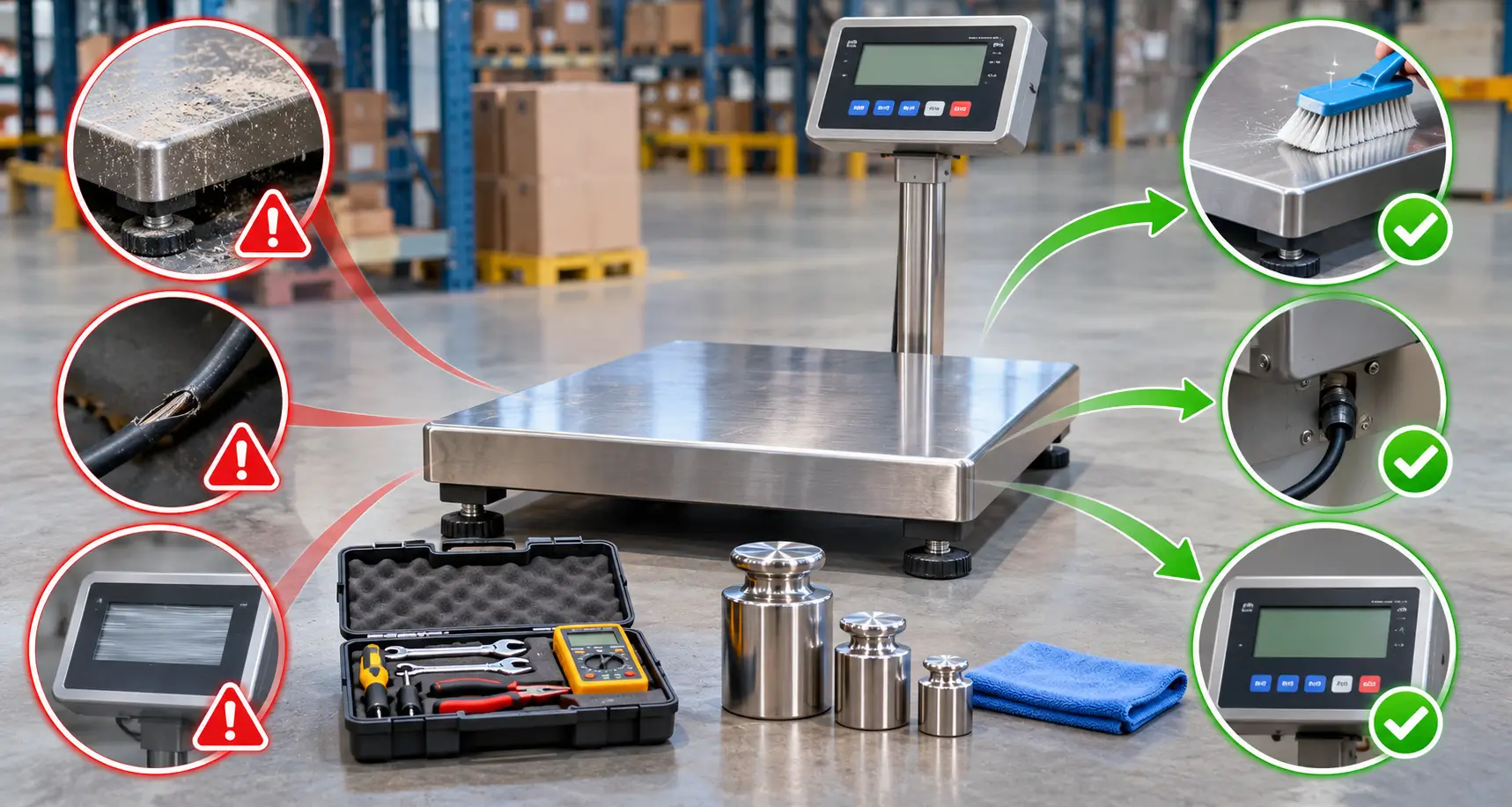
- Damaged cables
- Incorrect mounting
You can learn more about the component itself in our guide explaining what a load cell is and how it works.
Load-cell repairs and replacements should generally be handled by qualified technicians because the weighing system may require adjustment and calibration afterward.
11. Moisture Is Affecting the Scale
Water and electronics are not a good combination unless the equipment is designed for wet conditions.
Food-processing plants, kitchens, industrial washing areas, and outdoor facilities may expose scales to humidity, splashes, or regular cleaning.
Moisture can affect connectors, circuit boards, load cells, and indicators.
Do not assume every stainless-steel scale is automatically waterproof.
Businesses operating in demanding environments should review the benefits of waterproof weighing scales and choose equipment with appropriate protection for the intended application.
12. Counting Results Are Incorrect
Counting scales calculate quantity using average piece weight.
If the reference sample is too small, pieces vary significantly in weight, or the scale itself is inaccurate, the calculated quantity may be wrong.
Use a representative sample and make sure the individual pieces are reasonably consistent.
The weighing platform should also be clean and correctly calibrated.
Businesses can read more about how counting scales improve inventory accuracy when they are operated correctly.
13. Problems With Tank or Conveyor Weighing Systems
Integrated industrial systems can develop problems that are more complex than ordinary platform-scale faults.
For example, tank weighing systems may be affected by rigid piping, uneven support loading, vibration, or structural changes.
Similarly, conveyor belt weighing systems can experience inaccurate measurements because of belt tension, alignment, material buildup, speed-sensor issues, or poor calibration.
These systems should be inspected as complete installations rather than troubleshooting only the indicator.
When Should You Call a Technician?
Some weighing scale problems can be solved by cleaning the platform, checking power, correcting tare settings, or moving the equipment onto a stable surface.
Professional service is more appropriate when:
- Calibration repeatedly fails
- A load cell is damaged
- Measurements remain unstable
- Electrical components are exposed or damaged
- The scale has been seriously overloaded
- A forklift or heavy object has struck the equipment
- Integrated industrial systems show unexplained errors
Continuing to use a questionable scale can create larger operational problems than the cost of having it properly checked.
Final Thoughts
Most weighing scale problems begin with small warning signs.
A display that does not return to zero, inconsistent readings, damaged cables, repeated overload errors, or unusual measurement differences should not be ignored.
Regular cleaning, appropriate calibration, careful loading, environmental protection, and preventive maintenance can resolve or prevent many common issues.
More importantly, businesses should treat inaccurate measurements as an operational problem rather than just an equipment problem. Incorrect weight data can spread into inventory records, production decisions, freight documentation, and customer transactions.
For businesses in the UAE looking for commercial or industrial weighing solutions, Al Falah Scales provides weighing equipment for a wide variety of applications.
Frequently Asked Questions
Why is my weighing scale giving different readings?
Different readings may be caused by vibration, uneven surfaces, calibration drift, damaged load cells, poor positioning, or environmental interference.
Why won’t my scale return to zero?
Debris, incorrect tare settings, mechanical interference, installation problems, or load-cell drift may prevent the scale from returning to zero.
How do I know if my scale needs calibration?
If known weights display incorrectly, repeated measurements differ, or readings gradually drift, calibration should be checked.
Can overloading damage a weighing scale?
Yes. Excessive weight can damage load cells and structural components and may permanently affect accuracy.
Why is my digital scale display blank?
Common causes include a discharged battery, faulty adapter, loose connection, power failure, or indicator problem.
Can an uneven floor affect scale accuracy?
Yes. Industrial scales generally require a stable, level installation for reliable load distribution and measurement.
Can moisture damage a weighing scale?
Yes, unless the equipment is specifically designed for wet or washdown environments.
Can a damaged load cell be repaired?
Some faults may be repairable, but damaged load cells often require professional diagnosis or replacement followed by system calibration.
Should a scale be recalibrated after moving it?
It is good practice to verify accuracy after relocation, especially when the new installation conditions differ from the previous location.
Where can businesses find weighing solutions in the UAE?
Businesses can explore commercial and industrial weighing equipment through Al Falah Scales.