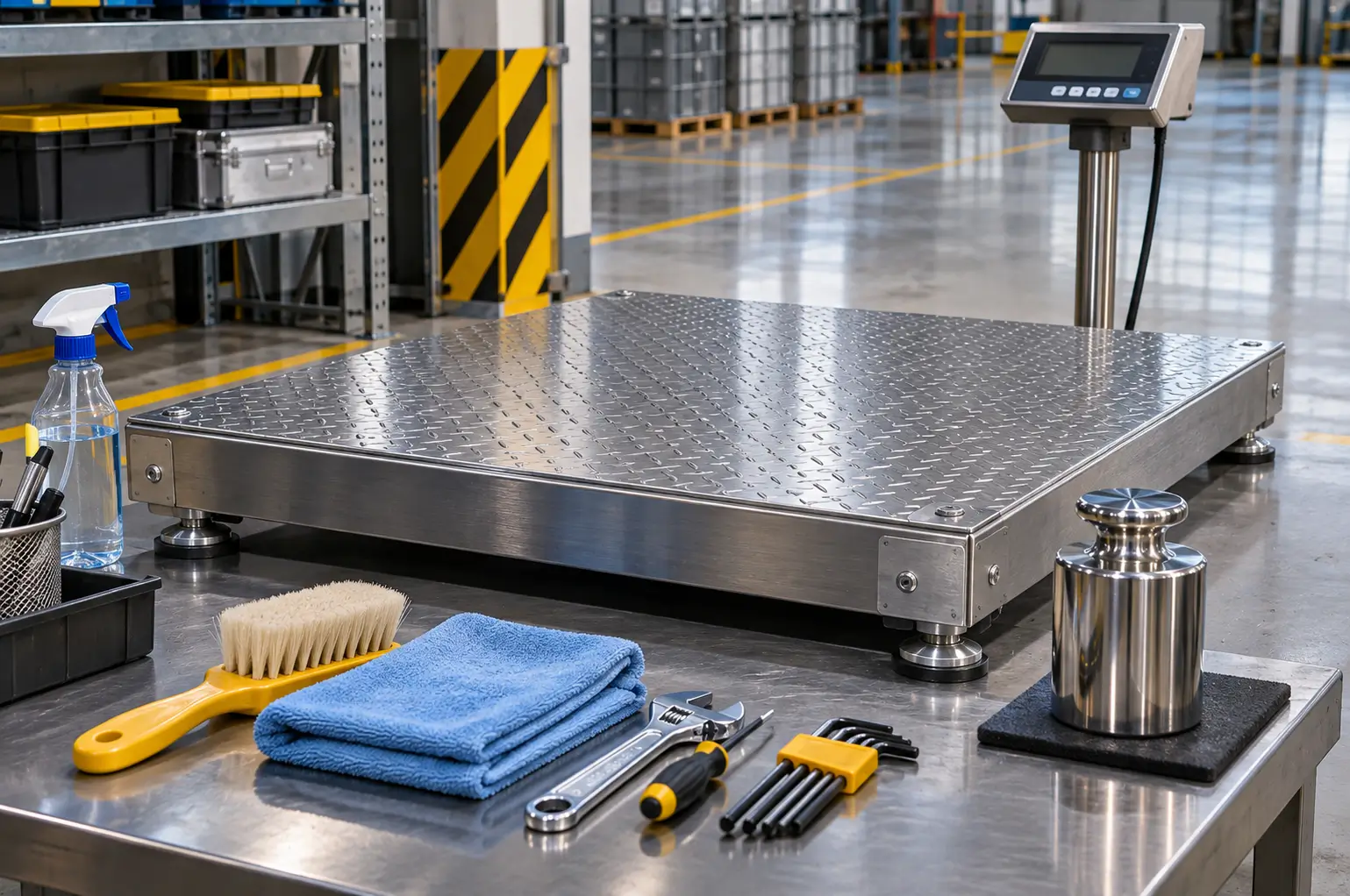
Industrial weighing scales often work in conditions that are far tougher than those faced by ordinary commercial scales. Heavy pallets are placed on platforms repeatedly, dust settles around moving components, forklifts operate nearby, and moisture, temperature changes, vibration, and accidental impacts can all affect performance.
A scale may continue switching on and displaying numbers while its accuracy slowly begins to drift.
That is why industrial weighing scale maintenance should not be treated as something businesses do only when equipment fails. Preventive maintenance helps protect measurement accuracy, reduce unplanned downtime, extend equipment life, and prevent inaccurate data from affecting inventory, production, shipping, or quality control.
For factories, warehouses, logistics companies, and processing facilities, a well-maintained scale is ultimately a more dependable business tool.
Why Industrial Scale Maintenance Matters
Industrial weighing systems are often connected directly to important operational decisions.
A warehouse may use scale readings to prepare freight documentation. A manufacturer may depend on weight to control raw-material quantities. A processing facility may use load cells to monitor tanks, hoppers, or production lines.
If the weighing system becomes inaccurate, the consequences can extend far beyond the scale itself.
Poor maintenance can lead to:
- Incorrect shipment weights
- Inventory discrepancies
- Material overuse
- Product inconsistencies
- Freight adjustments
- Production interruptions
- Premature equipment failure
Maintenance therefore protects both measurement accuracy and operational efficiency.
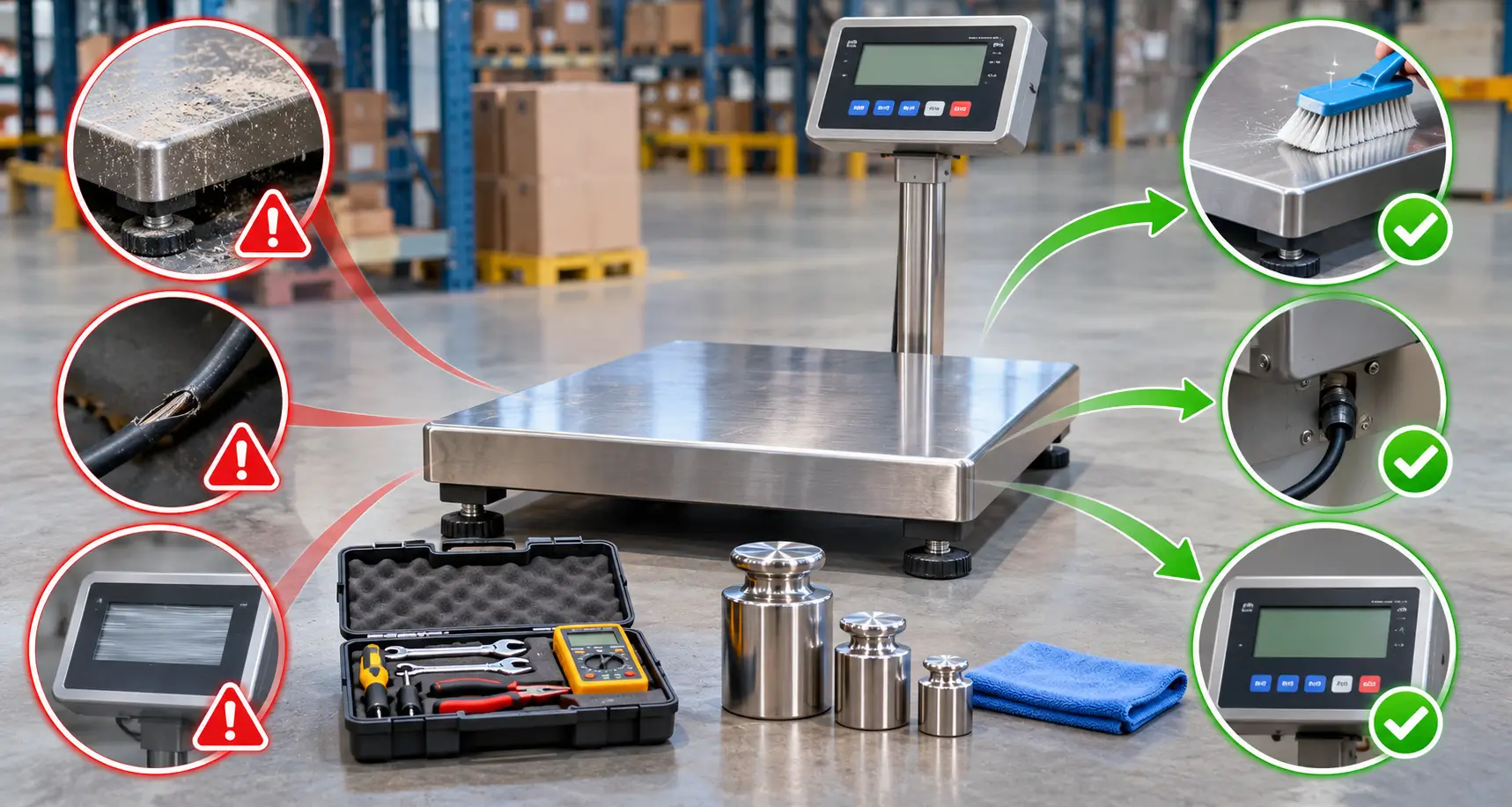
1. Keep the Weighing Platform Clean
Cleaning is one of the simplest maintenance tasks, but it is frequently overlooked.
Dust, product residue, packaging debris, stones, and other materials can collect around or underneath an industrial platform.
If debris restricts movement or creates contact between the weighing platform and surrounding structures, it may influence readings.
The cleaning method should match the working environment and scale design.
Dry facilities may require regular brushing or vacuuming, while food or wet-processing environments may need equipment specifically designed for washdown conditions.
Businesses operating in areas exposed to water should also understand the benefits of waterproof weighing scales before selecting or maintaining equipment.
Avoid directing water, chemicals, or high-pressure cleaning equipment toward components that are not rated for such exposure.
2. Never Regularly Overload the Scale
Every industrial scale has a maximum rated capacity.
Exceeding that limit can place unnecessary stress on the load cells, platform structure, and mounting components.
Even when a scale appears to survive an overload without visible damage, excessive force may affect measurement performance.
Warehouse staff should understand the scale’s maximum capacity and avoid dropping loads onto the platform.
A 2,000 kg pallet lowered carefully onto a suitable scale is very different from the same load being dropped aggressively from a forklift.
Repeated shock loading can shorten equipment life and eventually cause unstable or inaccurate readings.
3. Inspect Load Cells Regularly
Load cells are among the most important components in an industrial weighing system.
They convert the force created by the load into an electrical signal that the indicator can interpret as weight.
Because measurement accuracy depends heavily on these components, load cells should be inspected for signs of damage, corrosion, moisture entry, loose mounting, cable problems, or physical interference.
Businesses unfamiliar with their role can read more about what a load cell is and how it works.
Damaged load-cell cables deserve particular attention. Forklifts, rodents, sharp objects, equipment movement, or poor cable routing can damage insulation and create intermittent measurement problems.
4. Schedule Regular Calibration
Cleaning and visual inspection cannot confirm whether a scale is measuring accurately.
That requires calibration or measurement verification.
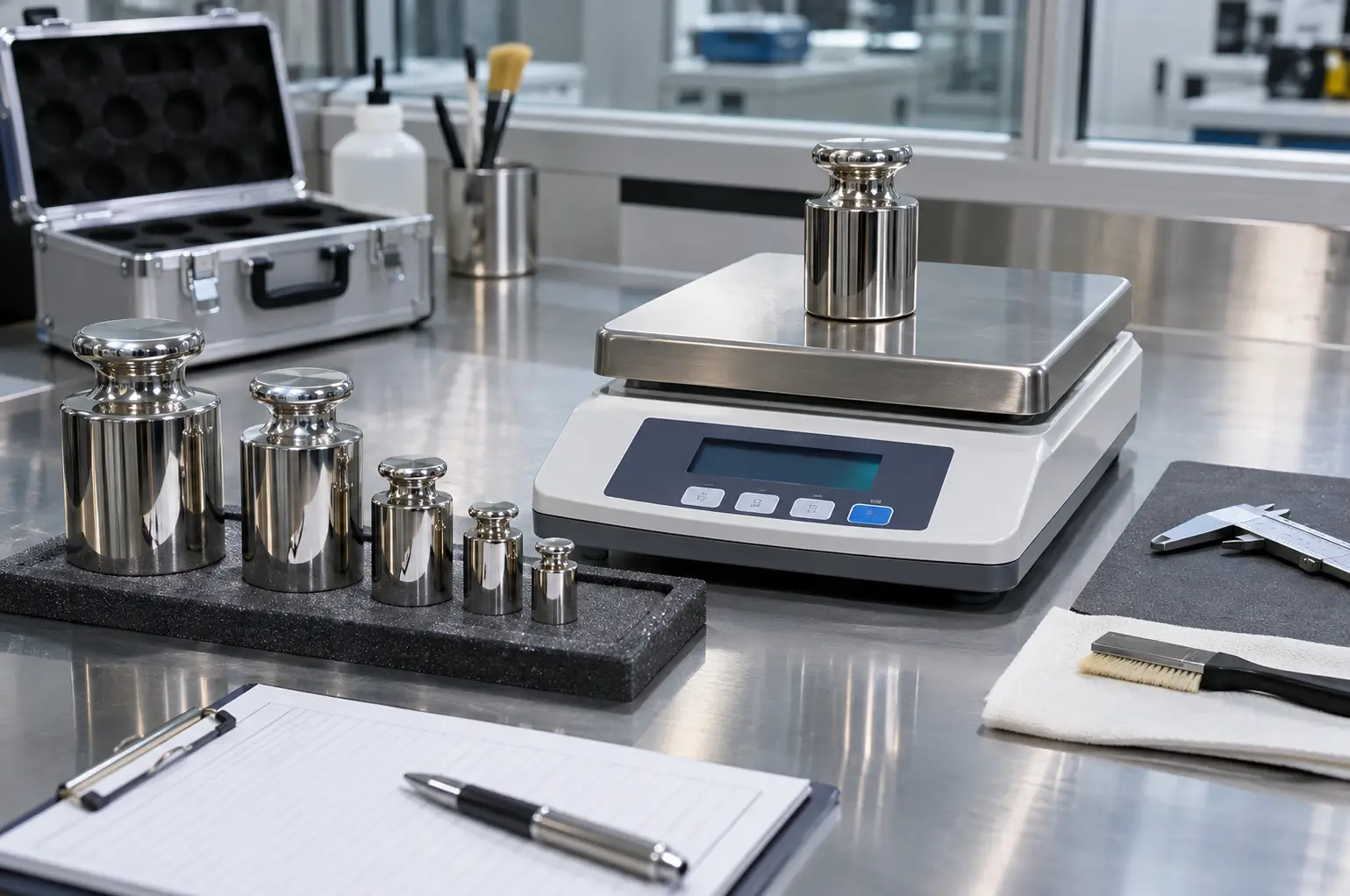
Calibration compares the scale’s readings against known reference weights and helps identify measurement drift.
The appropriate interval depends on usage frequency, environmental conditions, accuracy requirements, previous calibration results, and the importance of the measurement.
A heavily used warehouse scale may need more frequent verification than equipment used occasionally in a controlled room.
Businesses should treat regular weighing scale calibration as part of preventive maintenance rather than waiting for obvious inaccuracies to appear.
5. Check the Scale’s Level and Foundation
Industrial scales need a stable base.
An uneven or unstable floor can affect how force is distributed across a weighing platform.
This is particularly important for large platform, pallet, and floor scales where multiple load cells may support the structure.
If the scale is moved, the floor settles, or nearby construction changes the installation area, the equipment should be checked again.
Never assume that a scale remains correctly installed simply because it has been operating in the same location for years.
Changes in the surrounding environment can gradually influence performance.
6. Protect Equipment From Forklift Damage
Forklifts are one of the greatest practical risks to warehouse weighing equipment.
Drivers may accidentally strike:
- Scale platforms
- Indicators
- Junction boxes
- Cables
- Ramps
- Load-cell assemblies
Strategic installation can reduce these risks.
Where appropriate, protective barriers or bollards can prevent vehicles from hitting sensitive components while still allowing normal scale access.
This is especially important where pallet weighing scales are used in warehouse and logistics operations, as equipment is often installed directly within forklift traffic areas.
7. Watch for Unstable or Drifting Readings
Operators are often the first people to notice scale problems.
Warning signs can include:
- A display that does not return to zero
- Weight readings that fluctuate with a stationary load
- Different results when weighing the same item repeatedly
- Unexpected differences from known product weights
- Slow response times
These symptoms should not simply be ignored or corrected by repeatedly resetting the indicator.
An unstable reading may indicate mechanical interference, vibration, electrical problems, moisture, load-cell damage, or calibration drift.
Investigating early is usually easier than dealing with a complete failure later.
8. Reduce Vibration Where Possible
Industrial environments often contain conveyors, motors, compressors, mixers, and heavy machinery.
Vibration from this equipment can affect weighing stability, particularly when scales are installed nearby.
Where possible, weighing equipment should be positioned away from strong vibration sources or installed using appropriate engineering controls.
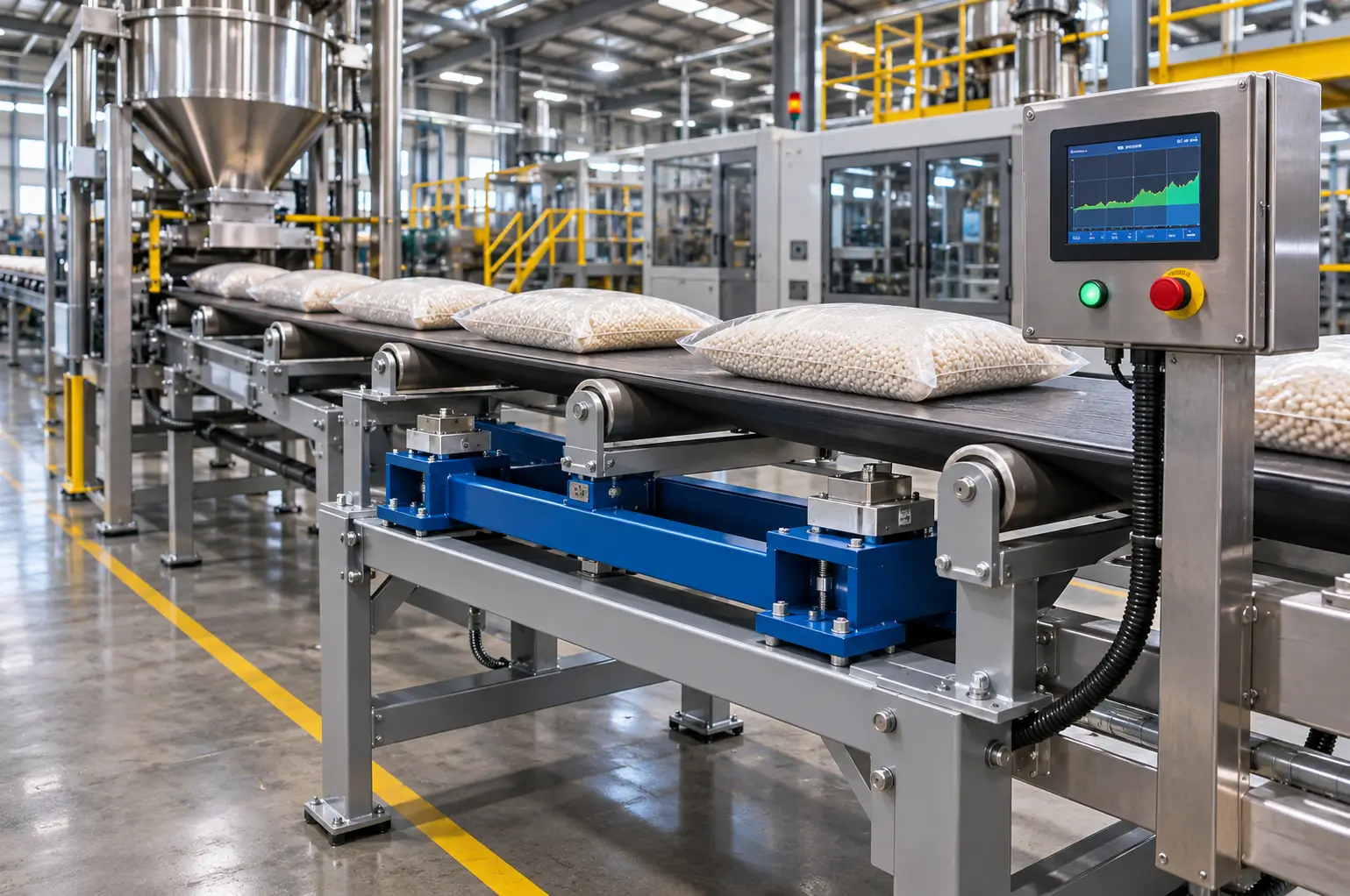
This becomes particularly important in continuous systems. For example, conveyor belt weighing systems used in manufacturing require proper mechanical alignment and stable operating conditions to produce dependable throughput measurements.
9. Inspect Cables and Electrical Connections
Industrial scales depend on electrical signals travelling from the load cells to junction boxes, indicators, controllers, or computers.
Loose connections, damaged cables, corrosion, or moisture can disrupt those signals.
Maintenance teams should periodically inspect accessible wiring and connectors.
Cables should not be crushed by pallets, stretched tightly across traffic areas, or left where employees and equipment can repeatedly damage them.
If a cable shows visible damage, it should be assessed rather than temporarily patched and forgotten.
Electrical problems can sometimes appear as weighing problems even when the mechanical parts of the scale are working correctly.
10. Maintain Specialised Weighing Systems Correctly
Not every industrial scale is a simple floor platform.
Factories may use tank, hopper, conveyor, pallet, or integrated weighing systems, each with its own maintenance considerations.
For instance, tank weighing systems can be affected by rigid piping, structural changes, vibration, and uneven loading.
Maintenance teams should therefore follow procedures designed for the specific weighing application instead of applying one generic checklist to every system.
11. Keep a Maintenance and Calibration Record
Industrial scale maintenance becomes more effective when it is documented.
Keep records of:
- Calibration dates
- Repairs
- Load-cell replacements
- Accuracy checks
- Cleaning schedules
- Fault reports
- Relocation
- Overload incidents
This history makes recurring problems easier to identify.
For example, if one scale repeatedly requires adjustment every few months, the issue may not simply be normal drift. There could be an environmental or mechanical cause that requires attention.
Maintenance records also help businesses plan service before equipment begins affecting operations.
12. Train Employees to Use Scales Correctly
Maintenance is not solely the responsibility of technicians.
Daily operators can either protect the equipment or unintentionally damage it.
Employees should know how to:
- Position loads correctly
- Avoid exceeding capacity
- Use tare and zero functions properly
- Report unstable readings
- Keep platforms clear
- Avoid impact loading
For businesses using counting scales for inventory accuracy, correct sampling and proper scale operation are equally important because inaccurate weight measurements can lead directly to incorrect quantity calculations.
When Should an Industrial Scale Be Serviced Immediately?
Some situations justify an inspection before the next scheduled maintenance date.
Arrange a check if the scale has been overloaded, struck by a forklift, moved to another location, exposed to unexpected water damage, repaired, or suddenly begins displaying inconsistent measurements.
The same applies after replacing a load cell or making structural changes around an integrated weighing system.
Continuing to use questionable equipment can allow inaccurate measurements to spread into production, shipping, and inventory records.
Final Thoughts
Long-term industrial weighing accuracy does not come from buying a high-quality scale and then ignoring it.
Reliable performance depends on regular cleaning, calibration, load-cell inspection, correct loading, stable installation, protected electrical components, and responsible daily operation.
Preventive maintenance also makes financial sense. Identifying a damaged cable, loose mounting point, or calibration issue early is usually less disruptive than dealing with inaccurate shipments, wasted raw materials, rejected production, or complete equipment failure.
For businesses in the UAE looking for weighing equipment for warehouses, manufacturing plants, logistics operations, and industrial facilities, Al Falah Scales offers solutions for a wide range of weighing applications.
Frequently Asked Questions
How often should industrial weighing scales be maintained?
Maintenance frequency depends on usage, environment, scale type, and accuracy requirements. Heavily used scales generally need more frequent inspections.
How often should an industrial scale be calibrated?
There is no universal interval. Calibration frequency should reflect usage intensity, accuracy requirements, operating conditions, and manufacturer or quality-system recommendations.
Can dirt affect weighing scale accuracy?
Yes. Debris beneath or around a weighing platform can restrict movement and potentially influence measurements.
What causes industrial scales to lose accuracy?
Common causes include overloading, impact, load-cell damage, vibration, moisture, temperature changes, mechanical interference, and calibration drift.
Can overloading permanently damage a scale?
Yes. Excessive loads can damage load cells or structural components and may cause permanent measurement problems.
Should a scale be calibrated after moving it?
It is advisable to verify the scale after relocation because changes in level, foundation, and installation conditions may affect performance.
How can I tell if a load cell is damaged?
Possible signs include unstable readings, failure to return to zero, inconsistent results, or unusual measurement differences. Proper testing may be required for confirmation.
Can forklifts damage industrial weighing scales?
Yes. Forklift impacts can damage platforms, cables, indicators, junction boxes, and load-cell assemblies.
Do tank and conveyor weighing systems need maintenance?
Yes. Integrated industrial systems require regular inspection, calibration, cleaning, and checks of mechanical and electrical components.
Where can businesses find industrial weighing solutions in the UAE?
Businesses can explore commercial and industrial weighing equipment through Al Falah Scales.